One Kitchen, Multiple Menus: How to Reduce Allergen Risks
A single kitchen preparing multiple menus can reduce the risk of allergen cross-contact if ingredients, equipment, and the order of work are clearly separated from the start.
.
Read Labels and Separate Ingredients Before Starting
Before beginning, check the labels to see which ingredients contain components that need special attention by reading the ingredient list, allergen information, and warning statements on the packaging.
The information on the label helps you plan which ingredients should be stored separately, which menus need specially prepared equipment, and what should be prepared first. If several people share the kitchen, labeling items or clearly designating storage areas can also help reduce mix-ups.
.
Separate Equipment That Comes into Contact with Food
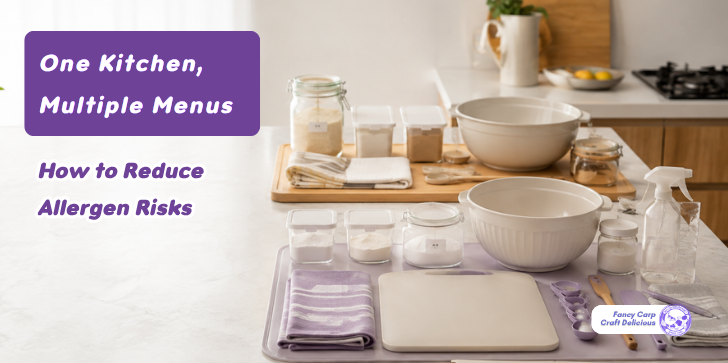
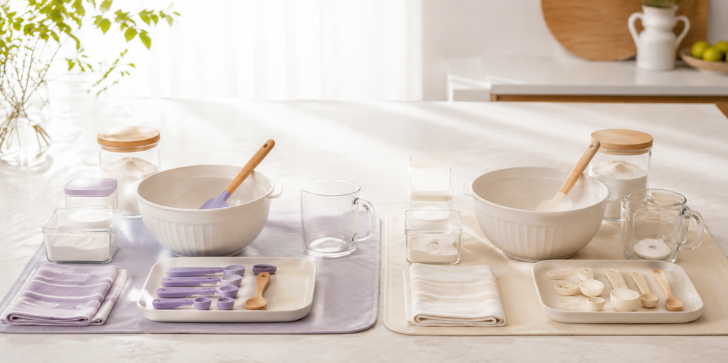
Mixing bowls, spatulas, measuring spoons, knives, cutting boards, trays, and containers used to hold food are equipment that should be clearly designated for specific menus.
.
.
If there is enough equipment, a separate set can be prepared specifically for menus that require extra care, using colors, symbols, or designated storage areas to make separation easier.
For equipment that must be shared, cleaning procedures should be established before it is used for the next menu to avoid confusion when preparing several dishes.
.
Clearly Plan the Order of Food Preparation
When preparing several menus in the same kitchen, the order should be planned before starting so that each step has suitable space and equipment.
Menus that need to avoid allergens should be prepared first in a clean area with clean equipment. Other menus can then be prepared according to the planned order to reduce the chance that food particles or ingredients from one menu may unintentionally come into contact with another.
If several items need to be prepared at the same time, the workspace can be clearly divided according to what is being prepared in each area, with separate containers for holding food to reduce the chance of spoons, spatulas, or ingredients being used across different menus during preparation.
.
Clean the Area Before Changing Menus
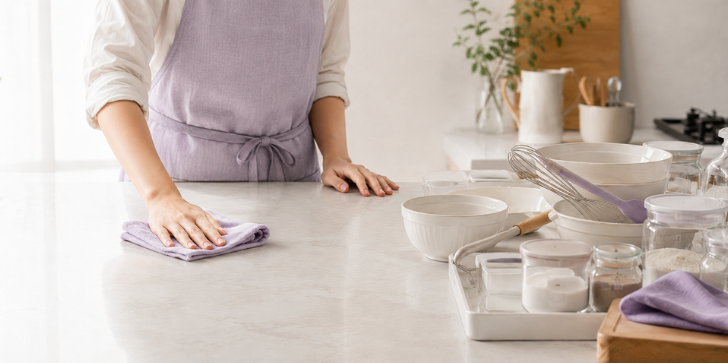
After finishing the preparation of one menu, the area should be made ready before starting the next one, rather than simply brushing away or wiping off visible food particles.
.
.
Preparation tables, cutting boards, knives, mixing bowls, spatulas, and shared equipment should be washed or cleaned appropriately. Hands should also be washed with soap and water after handling ingredients that require special care.
Cleaning cloths and cleaning tools should also be used carefully. If they have come into contact with food residue from one menu, they should not be used to wipe another area before being properly cleaned.
.
Communicate the Kitchen’s Limitations Honestly
Even when ingredients and equipment are separated, the preparation order is planned, and cleaning is carried out carefully, a kitchen that still shares some spaces or equipment should communicate those limitations honestly.
When preparing food for others, it should be clearly explained which ingredients are used in the kitchen and which steps still cannot completely separate the workspace or equipment, so that the person receiving the food has information to consider when making a decision.
Communicating which parts can be separated and which parts are still shared helps ensure that the information accurately reflects what the kitchen can actually do, without making assurances beyond the procedures that are in place.