From a Small Kitchen to Real Sales How to Make Your Recipes Consistent

A recipe that works well in a home kitchen may produce different results when the quantity increases, the dessert is made in advance, or it is prepared for customer delivery. Volume, timing, equipment, and resting periods all change the conditions surrounding the dessert. Adjusting a recipe for sale is therefore about more than preserving flavour. It requires clear numbers, defined steps, and specific checkpoints so repeated batches produce closely comparable quality each time.
.
When making a small quantity, it is still possible to taste, add, or adjust ingredients along the way based on familiarity. The dessert is also often eaten soon after it is made, so there is little need to account for resting, packaging, or transport. Once the quantity increases or the dessert is made for sale, these conditions immediately affect the recipe’s result.
.
A batch may need to cool, wait for packaging, remain on display for several hours, or travel before reaching the customer. A texture that is excellent straight from the steamer may not feel the same when the box is opened. A sales-ready recipe should answer these questions:
- Do repeated batches produce a similar flavour and texture?
- Does each batch yield a consistent number of pieces?
- Does the dessert remain appealing after resting for the actual sales period?
- Can the result still be controlled when production volume increases?
.
For example, khanom thuai that looks smooth while warm may release water after resting. Khanom chan that cooks evenly in one small tray may cook unevenly when several trays are placed in the same steamer. Khanom piak poon that is easy to stir in a small pot may thicken too quickly when the pot size changes. The original recipe should therefore be tested again under conditions that closely resemble real sales.
.
Turn Familiar Hand Movements into Instructions Others Can Follow
Phrases such as “about this much,” “stir until it looks right,” or “add a little more” may work when you know a recipe by heart, but they create variation between batches and make the recipe difficult to pass on to someone else. A consistent recipe begins by recording what can be measured. Include:
- The weight of every ingredient in grams
- The actual amount of water, coconut milk, or syrup used
- The order in which ingredients are mixed
- Resting, stirring, simmering, or steaming times
- The heat level or temperature used
- The sizes of the pot, tray, mould, and steamer
- The weight or number of pieces yielded by one recipe
- The dessert’s condition immediately after cooking and after resting
- The test date and result of each batch
.
A recipe from a small kitchen doesn’t have to be perfect from day one. The key is shifting from ‘cooking by feel’ to something that can be measured, recorded, and replicated. When your process is defined, the flavor that used to depend on guesswork becomes a consistent quality customers can trust. In time, the happiness of doing what you love can silently turn into a profitable business, beautifully blending your passion with a sustainable career.
.
Change One Variable at a Time to Identify the Real Cause
.
.
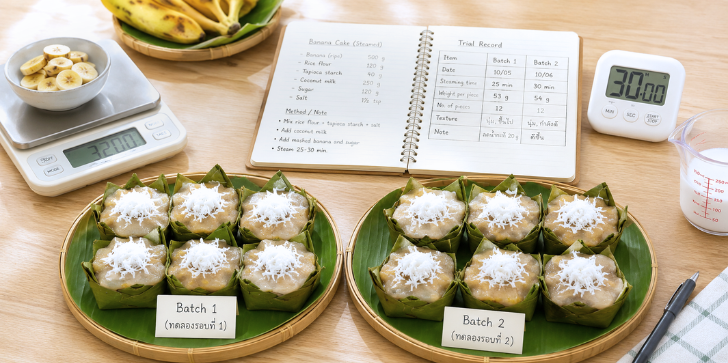
When a dessert does not turn out as intended, increasing the flour, reducing the coconut milk, changing the heat, and extending the steaming time all at once may improve the result—but it will not reveal the cause. A more accurate method is to change one variable at a time while keeping every other factor as close as possible to the previous batch.
.
If the dessert is too runny, begin by adjusting only the liquid while keeping the flour type, timing, and heat unchanged. If it firms up too quickly, examine the flour ratio, heating time, and moisture loss during resting separately. Before each test batch, answer these questions:
- When does the problem occur?
During mixing, heating, resting, or refrigeration?
.
- What exactly has changed?
Has the dessert become runny, dense, fragile, soggy, separated, or unable to hold its shape?
.
- Which variable is most likely involved?
Ingredient proportions, heat, time, the container, or the resting method?
.
- What single factor will change in this test?
Record the original number and the new number so the results can be compared.
.
Scaling Up Means More Than Multiplying the Ingredients
A recipe that produces one successful tray does not automatically produce five identical trays when every ingredient is multiplied by five.
.
As the quantity increases, the following may change as well:
- Mixing and stirring time
- The distribution of ingredients and heat
- The amount of steam and the position of trays in the steamer
- The time required for the dessert to cook
- Cooling and setting time
.
A large pot distributes heat differently from a small one, and a steamer holding several trays may not deliver equal steam to every level. A more controllable approach is to scale from one batch to two, then check flavour, texture, timing, and yield before expanding further. Some desserts may be better produced in several smaller batches than in one large pot because this limits the loss if something goes wrong.
.
Test the Recipe Along the Customer’s Real Journey
Tasting a dessert immediately after cooking is not enough because customers usually receive it only after it has rested, been packaged, and travelled.
.
Before opening for sales, simulate the dessert’s journey as closely as possible and check:
- Its condition after resting for 1–2 hours
- Texture changes after resting for the expected sales period
- Water release, surface drying, firmness, or changes in setting
- Steam or condensation accumulating inside the box
- Movement, cracking, or loss of shape during transport
- Quality after refrigeration and after being brought back to serving temperature
- How long the flavour and texture remain good
- The actual number of saleable pieces produced by one recipe
.
Checklist Before Accepting Orders
Before accepting orders, make sure the recipe can answer these questions:
- Have all ingredients been weighed in grams?
- Do the important steps have a clear sequence and timing?
- Have at least 2–3 repeated batches produced similar results?
- Do you know which factors make the dessert runny, firm, or set differently?
- Can the recipe still be controlled after increasing the quantity?
- Does one batch yield a consistent enough number of pieces for cost calculation?
- Does the dessert remain appealing after resting for the real sales period?
- Does the packaging preserve quality or create additional problems?
- Are the storage method and recommended eating period clearly defined?
- Can every step be completed in time for the number of orders you plan to accept?
If some questions still cannot be answered, the recipe may need further testing before the shop accepts a large volume of orders. This helps define what the kitchen can genuinely control.
.
A recipe developed in a small kitchen does not need to be perfect from the start. What matters is gradually turning instinctive steps into a process that can be measured, recorded, and repeated. As each step becomes clearer, the delicious results that once depended on experience and familiarity can become consistent quality that customers can expect every time. The joy of doing what you love may then grow into a profitable source of income, allowing you to turn your passion into a career—perhaps before you even realise it.
.